Mercedes E, S or V Class: Choosing the Right Car for the Journey

“Which one do I actually need?” — the most common booking-form question. The Mercedes E-Class, S-Class and V-Class each solve a different problem; choosing the right one is mostly about the journey, not the budget. Here is the actual decision tree, with examples from sixteen years of running all three.
The decision tree, in three questions
The vehicle class question reduces to three sub-questions. One. How many passengers and how many cases? Two. Will the vehicle be read by anyone other than the passenger (FBO concierge, hotel doorman, client at the destination)? Three. Will any meaningful work happen in the rear during the journey?
If the answer to question one is “two passengers, two cases,” the answer is E-Class unless overridden. If yes to question two and the destination is board-level, S-Class. If three or more passengers or four or more cases, V-Class. Most journeys resolve in fewer than ten seconds with these three rules.
Mercedes E-Class — the everyday executive saloon
The Mercedes E-Class is the everyday vehicle of the fleet. Saloon body style, four-door, capacity for one to three rear passengers and two large suitcases. Refined ride, mature interior, neither the showy presence of the S nor the cabin volume of the V. It is the vehicle that arrives without announcing itself, which is exactly what most executive transfers want.
Use cases: solo or paired airport transfers, long-distance city-to-city work, the routine M3/M25/M23 corridor. Indicative Farnborough to Heathrow fare: £97–£117. Farnborough to central London: £130–£165.
Mercedes S-Class — when the vehicle is read
The Mercedes S-Class is the premium saloon — quieter, more refined, with rear-seat space and finish materially above the E-Class. The relevant question is not “is the S-Class better than the E?” — it is “will anyone other than the passenger see the vehicle?” If a hotel doorman, a client at the destination, an FBO concierge, or a chalet team will read the vehicle on arrival, S-Class corrects that signal in a way no other choice does.
Use cases: board-level executive movements, jet-card holders to FAB, diplomatic transfers, embassy work, and any movement where the principal is being received by someone whose first impression matters. Indicative Farnborough to Heathrow: £165–£195. Farnborough to FAB to central London (S-Class for FBO): £225–£285.
Mercedes V-Class — group, family and luggage
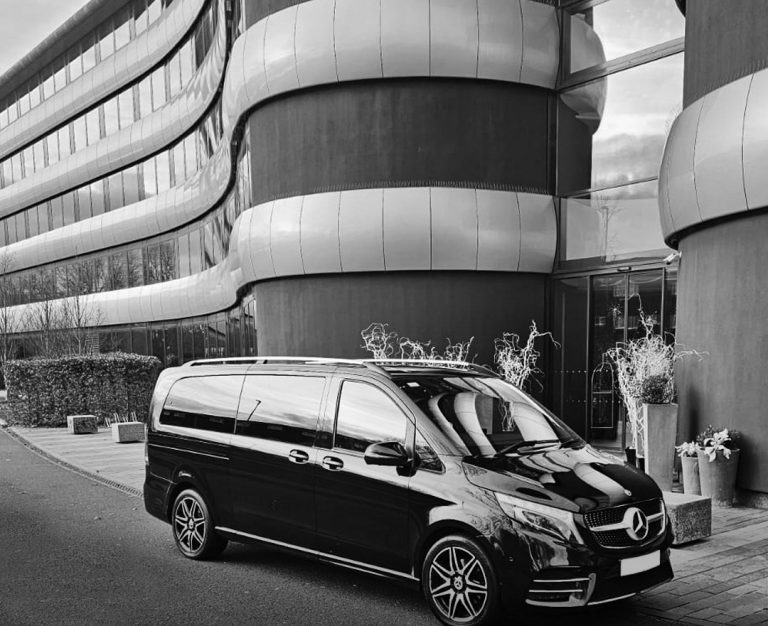
The Mercedes V-Class is the executive MPV — six rear passenger seats arranged conference-style or in a 2+2+2 configuration, with full luggage space behind. It is the right answer the moment a third passenger or a fourth case enters the picture, and the only correct answer for family runs to airports with hold luggage.
Use cases: family airport transfers (parents plus two children plus four cases), business team transfers (four executives plus laptop bags plus carry-on), cruise terminal runs (Southampton with hold luggage volumes that an E or S simply cannot accommodate), and roadshow work where the principal needs to brief the team between meetings. Indicative Farnborough to Heathrow: £137–£177. Farnborough to Southampton cruise: £165–£195.
Edge cases — Vito, Sprinter Jet, and when none of the above fit
Two edge cases sit outside the standard three-class fleet. The Mercedes Vito is used for high-luggage volumes that exceed even V-Class capacity (typically Mediterranean cruise transfers from Southampton with eight-plus cases). The Mercedes Sprinter Jet is reserved for corporate roadshow work or filming-crew transfers where eight to twelve passengers are moving together. Both are matched at booking when standing capacity rules indicate a fit.
Side-by-side comparison
| Vehicle | Capacity | Best for | LHR fare (from) |
|---|---|---|---|
| E-Class | 1–3 pax · 2 cases | Routine executive transfers; the everyday vehicle. | £97 |
| S-Class | 1–3 pax · 2 cases | Board-level, FBO, embassy, and any read-vehicle movement. | £165 |
| V-Class | Up to 6 pax · 6 cases | Family, group, hold-luggage, team transfers. | £137 |
Cost — what you actually pay for class
The honest cost stack: E-Class is the baseline, S-Class is roughly 1.6x the E-Class fare, V-Class is roughly 1.4x. The S-Class premium is real and reflects vehicle cost, depreciation, and rarity in the fleet (we run fewer S-Class vehicles than E-Class because they are not used as frequently, so each booking carries more of the standing cost).
For a Farnborough to Heathrow run, the S-Class premium of approximately £70 over the E-Class is not, in fare terms, large. For a 90-minute board-level airport transfer, it is rounding error. For a Saturday school run, it is unjustified. We are direct about this when asked.
How to book the right vehicle
Specify passenger count, case count, destination type (airport, hotel, FBO, residence, office), and whether the vehicle will be read by anyone at the destination. We match the vehicle class within the booking response. If the booking suggests a class that we believe is wrong for the journey, we say so — under-classing produces complaints; over-classing produces invoices that read as gouging. Neither is the relationship we want.
Mercedes class selection — your questions, answered
What is the difference between Mercedes E-Class and S-Class for chauffeur work?
The E-Class is the everyday executive saloon — refined, mature, and discreet for routine airport and city transfers. The S-Class is the premium saloon with materially better rear-seat space, finish and ride quality, used when the vehicle will be read by someone at the destination (FBO concierge, hotel doorman, board-level client). The S-Class premium is approximately 1.6x the E-Class fare.
When should I choose a Mercedes V-Class over an E-Class?
Choose V-Class the moment a third passenger or a fourth case enters the picture. Use cases include family airport transfers (parents plus two children plus four cases), business team transfers, cruise terminal runs with hold luggage, and roadshow work where briefing happens in transit. The V-Class also provides materially better leg room over long-distance journeys.
How many passengers fit in a Mercedes V-Class chauffeur vehicle?
Up to six rear passengers in a 2+2+2 configuration, or four in a conference-style facing seat configuration. Luggage capacity is six large cases plus airline carry-on. The V-Class is the largest standard chauffeur vehicle in the fleet before stepping up to a Vito (for higher luggage volumes) or a Sprinter Jet (for eight-plus passengers).
Is an S-Class worth the extra cost for an airport transfer?
It depends on what happens at the airport. For a routine drop-off at a commercial terminal where the vehicle is not read, no — the E-Class delivers the same journey at a lower fare. For an FBO arrival at FAB, a board-level inbound at Heathrow VIP, or any transfer where flight crew or concierge staff will read the vehicle, S-Class is justified.
How much more does a Mercedes V-Class cost compared to an E-Class?
Roughly 1.4x. For a Farnborough to Heathrow transfer, that is the difference between £97–£117 (E-Class) and £137–£177 (V-Class). The premium reflects vehicle cost, fuel, and the larger interior space — but is materially less than the S-Class premium.
Do you offer Mercedes Vito or Sprinter Jet?
Yes, for edge-case requirements. Vito for high-luggage cruise transfers with eight-plus cases. Sprinter Jet for corporate roadshow or filming-crew transfers with eight to twelve passengers. Both are matched at booking when capacity rules indicate fit; neither is a default vehicle.
What if I do not know which vehicle class to book?
Tell us the journey — passenger count, case count, destination, and whether anyone other than you will see the vehicle on arrival. We match the class within the booking response. If we believe the class you have requested is wrong for the journey, we say so before confirming.
- Tripadvisor Travellers’ Choice 2020, 2023 & 2026
- 525 verified Google reviews
- Established 2009 · 16 years on the Hampshire circuit
- Mercedes E · S · V Class fleet