Farnborough Airport (FAB): The Quiet Side of Private Aviation Travel

“Which terminal at Farnborough?” — there are no terminals. FAB is the United Kingdom’s premier business aviation airport, where the journey from car door to cabin door is measured in minutes, not queues. After sixteen years running a Mercedes-only chauffeur fleet five miles from the airfield, here is what private aviation passengers should actually expect from the ground side of the trip — and why the wrong vehicle at TAG Farnborough quietly says everything before the FBO door even opens.
What Farnborough Airport (FAB) actually is
Farnborough Airport — IATA FAB, ICAO EGLF — is the United Kingdom’s designated business aviation airport. There is no scheduled commercial traffic. There are no terminals in the high-street sense. There is a single, purpose-built FBO operated by TAG Farnborough Airport, an apron, two business jet hangars at the eastern end of the runway, and a road approach that delivers a passenger from the A325 to a waiting Gulfstream in under two minutes.
That last detail is the entire point. FAB exists so private aviation passengers do not pass through queues, retail concourses, or escalators. The airport handles roughly 35,000 movements a year — a fraction of Heathrow — and yet it serves a passenger profile for whom an extra forty minutes of friction at the kerb is not an inconvenience but a contract issue.
How an FBO arrival differs from a commercial terminal
At Heathrow Terminal 5, a chauffeur drops a passenger at a Departures Drop-off bay, the passenger walks into a 90-metre queue, and the chauffeur leaves. At Farnborough, the chauffeur drives the passenger past the security gate, through to the FBO forecourt, into a marble-floored lounge with espresso and a copy of the Financial Times, and — five minutes later — directly onto the apron in a courtesy car that covers the final 80 metres to the aircraft door.
The chauffeur waits in the FBO car park, hands over the luggage to ground crew if requested, and is gone before the passenger has finished their espresso. There is no curbside controversy, no parking ticket roulette, no “sorry sir, you can’t stop here”. The protocol is invisible because everyone — the FBO, the chauffeur, the flight crew — is rehearsed.
Who actually flies through FAB
The misconception is that FAB is for film stars. It isn’t — at least not primarily. The bulk of FAB traffic is corporate: M&A teams flying to Frankfurt before market open, family offices repositioning between London and Geneva, principals of FTSE-listed firms making the four-stops-in-a-day European circuit that scheduled aviation simply cannot accommodate. Add to that medical evacuation flights, Royal Family movements, government delegations during the Farnborough International Airshow, and a steady stream of fractional jet members on programmes like NetJets, VistaJet and Flexjet.
What unites them is not wealth — it is calendar density. The cost of the jet is dwarfed by the cost of being in the wrong city at 10:30. The ground transfer is the fragile final link in that chain.
The ground-side journey: Farnborough town to the apron
The geography is unusually kind. The chauffeur pickup point — anywhere within central Farnborough, the GU14 area, or the surrounding villages of Fleet, Cove, Mytchett or Frimley — sits typically four to seven minutes from the FAB main gate at Ively Road. From the FBO forecourt, the courtesy car covers the final airside leg in roughly ninety seconds.
For inbound passengers the sequence reverses. The aircraft taxis to the FBO stand, customs and Border Force clearance happens inside the lounge (private aviation processing is materially faster than at LHR or LGW), and the chauffeur is already on the forecourt — having been notified by the operator the moment the wheels touched the runway. From wheels-down to moving in a Mercedes S-Class is generally under twelve minutes.
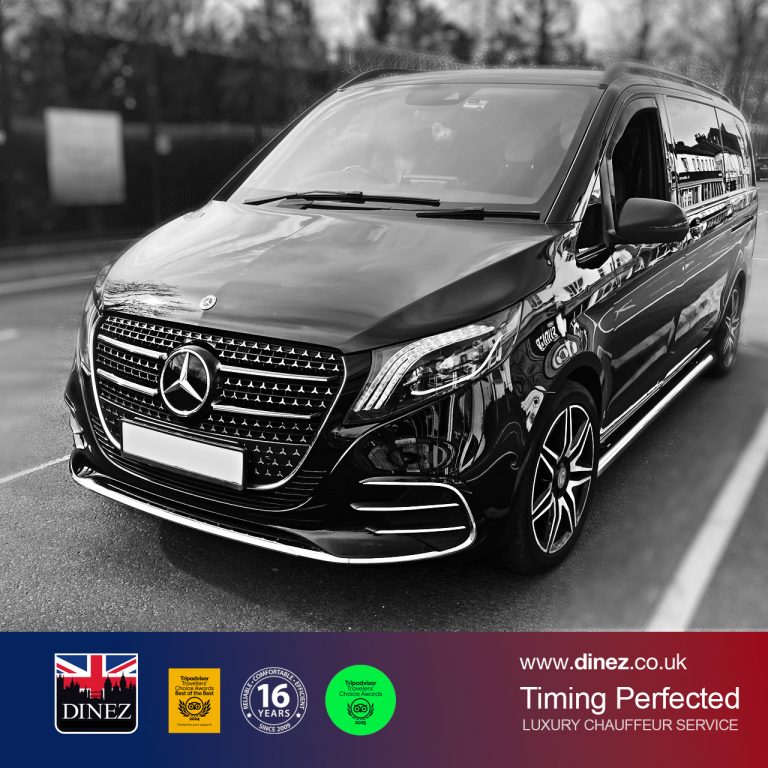
Vehicle class for private aviation: E, S or V
The vehicle that meets a Gulfstream G650 at the FBO forecourt is a quiet but precise statement. An aged minicab in the parking line — visible to the flight crew, the FBO concierge, and any other principal who happens to be arriving — undermines the entire choreography. Below is how the Mercedes fleet is matched to private aviation arrivals:
| Vehicle | Best for | Indicative fare (FAB ↔ central London) |
|---|---|---|
| Mercedes E-Class Saloon · 1–3 pax · 2 large cases | Solo principal or executive pair on a routine FAB transfer. | From £165 – £215 |
| Mercedes S-Class Premium saloon · 1–3 pax · 2 large cases | Diplomatic, board-level, jet card holder, or anywhere the FBO car park reads the vehicle before the passenger. | From £225 – £285 |
| Mercedes V-Class Executive MPV · up to 6 pax · 6 cases | Family office repositioning, four-person M&A team with hold luggage, or principal plus close protection. | From £205 – £275 |
Indicative pricing for FAB to central London W1/SW1 zones. Exact fixed quote depends on collection point, time of day, and any waiting required for international Border Force clearance.
Discretion as a deliverable, not a buzzword
Private aviation passengers buy discretion. The chauffeur arm of that equation is straightforward: no driver chat unless invited, no questions about the destination beyond what is operationally required, no photographs of the aircraft, no name on the placard if a name might be conspicuous, and a vehicle that arrives early enough to be invisible.
For high-profile movements — visiting heads of state, principal-only flights, situations where the kerb itself is sensitive — the FBO will coordinate the chauffeur entry separately, and the vehicle is screened through the airside gate. This is not a marketing add-on. It is built into how Farnborough operates.
Route pairings: FAB to London, Le Bourget, Geneva, Zurich
Most FAB ground transfers connect to one of a small set of European city pairs. Inbound passengers from Le Bourget, Linate, Geneva or Zurich are typically heading to Mayfair, Belgravia, Knightsbridge, or the City. Outbound to Farnborough is the same trip in reverse, often timed for an 06:30 flight slot to land in central Europe before market open.
The ground side of these journeys repeats certain shapes. A Mayfair pickup at 05:50 for an 06:45 wheels-up. A City office pickup at 16:30 for a 17:30 wheels-up to Geneva. A Knightsbridge return at 19:45 from a wheels-down at 19:20. None of these times tolerate dispatch friction, which is why the chauffeur arm is generally a named relationship, not a marketplace lottery.
FAB during Farnborough International Airshow week
For one week every two years the Farnborough International Airshow turns FAB and the surrounding road network into something approaching organised chaos. The airshow is the single largest civilian aviation event in the world after the Paris Air Show, and the volume of business jet movements during the week routinely doubles. Routes such as A325, Ively Road and the M3 J4a corridor saturate at peak times.
Local knowledge during airshow week is not optional — it is the entire product. Knowing which Farnborough side roads remain passable, which gates are restricted to credential holders, and which times the police diversion plans activate, is what separates an operator embedded in GU14 since 2009 from a London chauffeur firm dispatched in for the week.
Cost vs cost-of-failure on a private aviation ground transfer
The chauffeur element of a private aviation trip is, in fare terms, a rounding error. A Mercedes S-Class from a Mayfair address to FAB is typically £225 to £285. The aircraft itself, once airborne, costs that figure roughly every six to nine minutes. Cost optimisation on the ground transfer makes no rational sense — and yet it is occasionally attempted.
The ride that costs £40 less and arrives ten minutes late is not a saving. The aircraft does not wait. Slot times at FAB are tight, fuel uplift planning is fixed, and an onward European slot at Le Bourget or Linate is decidedly not flexible. The right way to think about it is that the chauffeur is the only part of the trip the operator can fully control — so it should be procured to fail safely, not to save five percent.
How to book a chauffeur for FAB
Booking is straightforward. We need three pieces of information: collection address, FAB tail number or operator name (so we can confirm with the FBO), and whether this is a routine repeat movement or a one-off. Repeat movements — the principal who flies the same Geneva pattern monthly — are usually handled on a corporate account with a single point of contact and standing instructions. One-offs go through the booking form or a direct phone call.
For inbound flights, we accept the operator’s ETA, monitor it live, and adjust the chauffeur dispatch accordingly. There is no charge for the first 60 minutes of waiting after wheels-down — Border Force processing for international arrivals can take that long, and a passenger should never feel rushed off an aircraft because their chauffeur is being charged.
Farnborough Airport chauffeur — your questions, answered
What does FAB stand for?
FAB is the IATA airport code for Farnborough Airport in Hampshire, the United Kingdom’s designated business aviation airport. The ICAO code is EGLF. There is no commercial scheduled traffic — FAB serves private and business jet movements only, operated by TAG Farnborough Airport.
Can a chauffeur drive me directly to my aircraft at Farnborough?
Not in your booked vehicle — for security reasons, only screened airside vehicles can cross to the apron. Your chauffeur drops you at the FBO forecourt; the FBO then runs you across the apron in a courtesy car, typically a 90-second journey. The choreography is essentially seamless from the passenger’s perspective.
How much is a chauffeur from Farnborough Airport to central London?
Indicative pricing is £165–£215 in a Mercedes E-Class, £225–£285 in an S-Class, and £205–£275 in a V-Class for an FAB to W1/SW1 transfer. All quotes are fixed and all-inclusive — no metered charges, no surcharges for waiting on Border Force clearance up to 60 minutes after wheels-down.
Do you handle international arrivals at FAB requiring Border Force clearance?
Yes. The chauffeur is dispatched to be on the FBO forecourt as the aircraft is on final approach. Border Force processes private aviation passengers inside the FBO lounge — typically faster than a commercial terminal, but it can run 20–60 minutes for non-EU passport holders. The first 60 minutes of waiting are included in the fixed fare.
Can I book a chauffeur for FAB during the Farnborough International Airshow?
Yes, but book early. Airshow week (typically the third week of July, biennially) is the busiest period in the local calendar, and routes near Ively Road and the A325 are heavily restricted. We have run airshow logistics every cycle since 2010 and hold standing arrangements with several exhibiting airframers.
Do you offer S-Class for jet card holders and FBO movements?
Yes. The Mercedes S-Class is the everyday vehicle for jet card members, family offices and board-level movements through FAB. It reads correctly at the FBO forecourt — a quiet but precise statement to flight crew, FBO staff and any other principal arriving alongside.
Can the same chauffeur cover both legs of a same-day trip?
For movements where you depart from FAB in the morning and return the same day or next day, we can hold the same named chauffeur for both legs at no markup. This is the default for corporate account holders and for high-profile movements where vehicle and driver continuity is part of the brief.
- Tripadvisor Travellers’ Choice 2020, 2023 & 2026
- 525 verified Google reviews
- Established 2009 · 16 years on the FAB run
- Mercedes E · S · V Class fleet