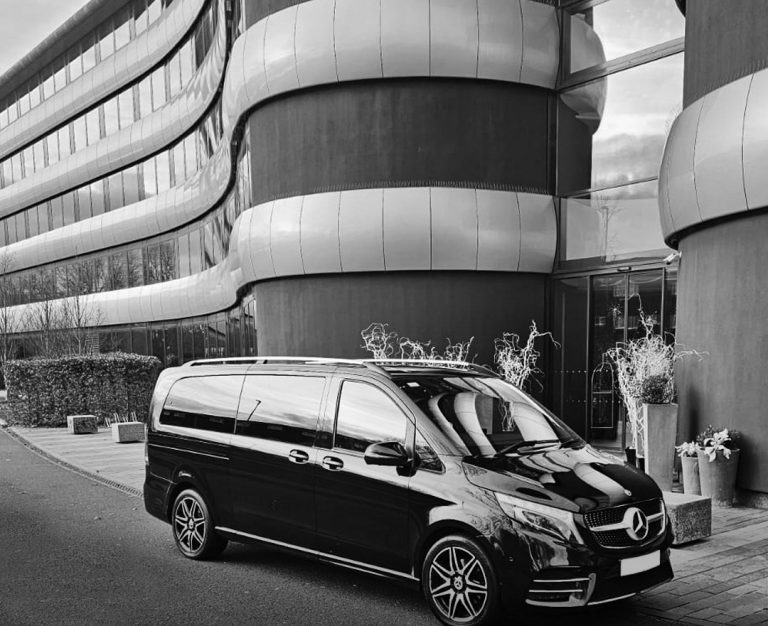
Chauffeur vs Taxi vs Uber: What UK Business Travellers Are Actually Choosing in 2026

“Which one actually arrives on time?” — that’s the question the procurement form never asks, but every traveller eventually does. After sixteen years moving executives, finance teams, diplomats and family principals between Farnborough and the major UK airports, the difference between a chauffeur, a taxi and an app cab is not abstract. It shows up at 5am, at the kerbside, in the boot.
What UK business travellers actually ask in 2026
In 2026 the question for a UK business traveller has shifted. It is no longer “which is cheapest?” — it is “which one will not put my 7am board meeting at risk, and which one looks correct when a client steps out of it?” Procurement teams have started building those two questions directly into ground-transport policy, and the honest answer is rarely the one that comes back from a price comparison.
The three categories — chauffeur, taxi, Uber / app cab — are not three flavours of the same service. They are three different products, with three different operating economics, three different failure modes, and three very different impressions left on the passenger.
Three categories, three different products
A licensed local taxi is a regulated, on-demand service. The driver is local, the vehicle is licensed by the borough council, the meter (or fixed price) is set against published tariffs. It is excellent for short notice, in-town, no-stakes journeys.
An app cab — Uber, Bolt and the equivalents — is a marketplace. The platform takes a commission, the driver is independently contracted, the vehicle and driver are confirmed only minutes before pickup. It is engineered for low cost and high volume, not for the 4:30am pickup before a transatlantic flight.
A chauffeur service is a different category entirely. The vehicle is selected and assigned in advance. The driver is briefed, named, and confirmed by photograph the day before. Flight monitoring runs from the moment the booking is taken. The fare is fixed at booking, not metered, and it includes the parts that other services charge for separately — meet & greet, parking, waiting, terminal change.
Side-by-side: chauffeur · taxi · Uber
The table below summarises how the three categories compare on the dimensions that actually matter for business travel from the South-East. Pricing is indicative for a Farnborough → Heathrow run as a reference point.
| Criterion | Chauffeur | Local taxi | Uber / app cab |
|---|---|---|---|
| Price (Farnborough → LHR) | From £97 fixed | £70-£110 metered | £55-£140 surge |
| Driver named in advance | Yes, with photo | Sometimes | No — assigned at pickup |
| Flight monitoring | Live, free | Manual call | None |
| Meet & greet at terminal | Included | Sometimes, fee | Kerbside pickup zone |
| Vehicle class | Mercedes E · S · V | Mixed saloon | Variable |
| Best suited to | Time-sensitive, client-facing | Local, in-town runs | Casual, low-stakes |
Prices indicative. App-cab pricing fluctuates with surge multipliers; chauffeur fare is locked at booking.
Punctuality & flight monitoring
Punctuality is where the three categories visibly separate. A chauffeur operator pulls flight data — landing time, terminal — at the moment the booking is created and again every few minutes from forty-eight hours before pickup. If the flight slips by ninety minutes, the pickup time slips by ninety minutes. There is no phone call to make and no “no-show” fee for a delay that was never the passenger’s fault.
A local taxi can do this if you call the office. An app cab cannot: you re-book on landing, queue with everyone else, and absorb whatever surge multiplier the algorithm decides to apply at that hour.
Cost vs cost-of-failure
The headline price is rarely the meaningful number. The meaningful number is the cost of the journey going wrong: a missed flight, a connection lost, a client kept waiting in reception, a board paper undelivered. UK business travellers in 2026 increasingly account for this directly — a £40 saving on a Heathrow run is a poor trade against a £450 same-day rebooking fee.
A chauffeur quote feels higher because it is all-inclusive: meet & greet, parking, waiting, monitoring, briefing. An app cab feels lower because most of those costs are externalised onto the passenger, payable in stress, time, and risk.
Driver vetting, briefing & consistency
A chauffeur is not simply “a driver in a nice car.” Vetting includes DBS check, a driving record audit, a presentation standard, and route familiarity for every airport, FBO, hotel and venue the operator covers. Briefing means the driver knows the passenger’s name, flight number, terminal, mobility needs, and any preference recorded against the account.
Local taxis vary. App-cab platforms publish a star rating but do not brief the driver, who in any case did not exist in your booking thirty seconds before pickup. For a CFO collecting an investor at Heathrow at 10pm on a Sunday, that gap is the entire point.
Airport pickup: kerb, app, or meet & greet
The airport pickup is where the impression is made. A chauffeur waits in arrivals at a fixed, pre-agreed point with a name board — terminal-specific, not a postcode. A local taxi may do the same, often for an additional fee. An app cab pickup means the passenger walks to a designated pickup zone with their luggage, scans for a number plate among twenty other cars, and waits in weather.
For a returning principal, the airline crew, the family with a tired child, the visiting investor — meet & greet is rarely a luxury. It is risk reduction.
Vehicle class & client perception
A chauffeur fleet is selected: Mercedes E-Class for solo executives, S-Class for diplomatic and private-aviation work, V-Class for teams, families, and roadshow logistics. The car is washed and vacuumed before the run. Bottled water sits in the door pocket. Phone chargers are correct for the passenger’s device.
Local taxis and app cabs deliver mixed saloons. The car may be a current Toyota or a tired Skoda. For a journey where the passenger is a client of yours, the difference is not vanity — it is the fifteen seconds between a meeting opening well and a meeting opening with an apology.
When each option actually wins
Each of the three categories has the right context. Local taxi wins for short, in-town runs in GU14 and surrounding postcodes — the school pickup, the station hop, the dinner across town. App cab wins for casual, low-stakes journeys where time, vehicle, and driver identity do not materially matter. Chauffeur wins everywhere a journey carries weight: a 5am airport run before a transatlantic flight, a board member arriving for an annual meeting, a wedding morning, a Royal Albert Hall booking, a £40,000 deal that hangs on arriving on time.
Procurement teams in 2026 are increasingly tiering ground transport accordingly: app cabs for casual, taxis for local, chauffeur for time-sensitive and client-facing. The savings come from putting the right product against the right journey — not from defaulting to the cheapest.
Chauffeur vs taxi vs Uber — FAQ
Is a chauffeur really worth the extra cost over an Uber?
For a leisure trip across town, no. For a 5am Heathrow run, a board meeting, an investor pickup or a wedding morning — yes. The premium pays for fixed price, named driver in advance, live flight monitoring, included meet & greet, and a vehicle selected for the journey. It is the difference between buying a journey and buying the absence of risk.
Does a chauffeur charge waiting time if my flight is delayed?
No. Live flight monitoring is included from booking. If your flight is delayed by ninety minutes, the pickup time moves by ninety minutes — without a phone call, an extra fee, or a “no-show” charge. App cabs and most local taxis do not work this way.
Are Uber drivers vetted to the same standard?
Uber requires basic licensing and a DBS check at sign-up. A chauffeur operator runs ongoing audits — driving record, presentation standard, route familiarity, briefing for each booking. The driver of an app cab is unknown until two minutes before pickup; a chauffeur is named, photographed and confirmed the day before.
Will a chauffeur quote include parking and meet & greet?
At Farnborough Taxi Cabs, yes — both are included in the fixed fare. There is no short-stay parking surcharge and no separate meet-and-greet fee. The driver waits in arrivals at a named meeting point at every Heathrow terminal.
When should a business default to an Uber rather than a chauffeur?
For casual, low-stakes journeys where time, vehicle, and driver identity do not matter — late-evening cross-town hops, a colleague’s leaving drinks, a station run when the trains are running normally. The economics flip when the journey carries weight: airport runs, client pickups, time-critical meetings, anything where a missed connection has a cost.
Can a chauffeur invoice my company directly?
Yes. Corporate accounts are billed monthly against a single PO with a full audit trail per journey — date, route, vehicle, driver, fare. Receipts are produced in the format your finance team requires. App cabs and most local taxis cannot offer this level of consolidation.
What about same-day or last-minute bookings?
A chauffeur can usually accommodate same-day bookings subject to fleet availability — call 01252 265051 or message via WhatsApp. The advantages of a chauffeur (named driver, fixed price, flight monitoring) all still apply. For under-three-hour notice, an app cab will normally arrive faster, with the trade-offs that implies.
Similar Posts
Combined Naval Event 2027: Moving 85 Nations Through Farnborough
Combined Naval Event 2027 brings more than 2,700 senior naval leaders from over 85 nations to Farnborough on 25-27 May. A Hampshire operator on gate routing, hotel spread, FBO handovers and how multi-nation delegation transport is really organised.
Security & Policing 2027: The Delegation Transport Brief for Farnborough
Security & Policing 2027 runs 16-18 March at Farnborough International. A Hampshire operator on gate routing, the Gate B drop-off layby, arrival windows and how multi-day delegation transport is actually organised.